

Uncategorized
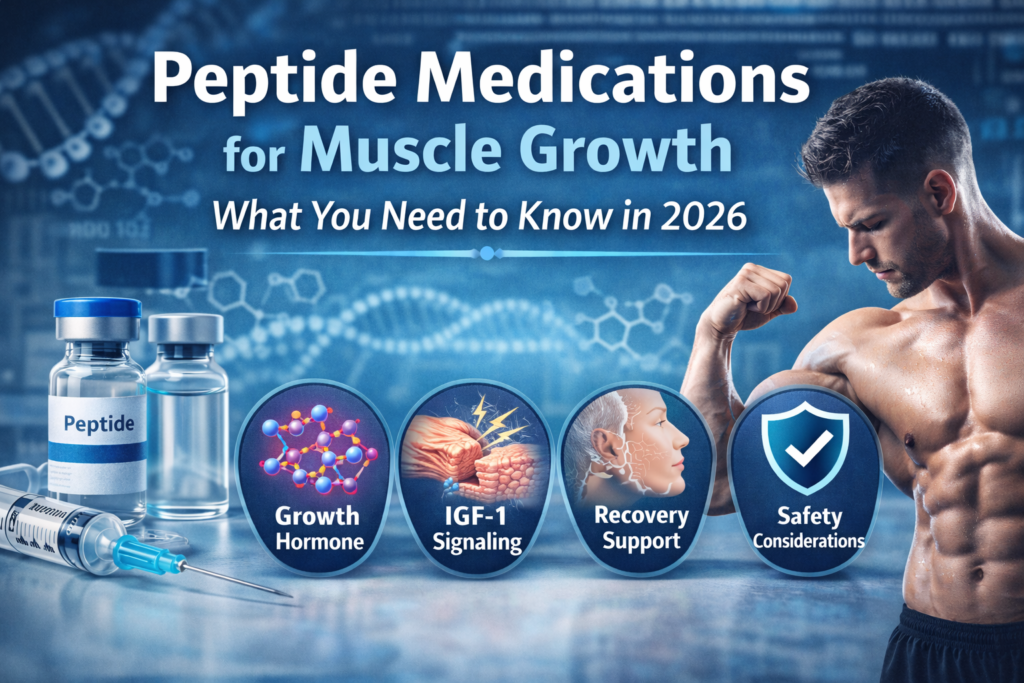
Peptide Medications for Muscle Growth: What You Need to Know in 2026
Feb
Interest in peptide medications for muscle growth continues to expand in 2026 as researchers, clinicians, and performance science experts explore new ways to understand muscle hypertrophy and recovery pathways. Peptides have become a major topic in biotechnology and sports science discussions because of their ability to influence hormone signaling, cellular repair mechanisms, and protein synthesis pathways.
But what exactly are muscle growth peptides? How do they work? And what should you know about safety and regulation?
This guide explains the science, categories, and key considerations surrounding muscle-building peptides.
What Are Peptide Medications?
Peptides are short chains of amino acids that function as signaling molecules in the body. Certain peptide medications are studied for their influence on growth hormone secretion, insulin-like growth factor (IGF-1), and muscle protein synthesis.
In clinical and research contexts, peptides are designed to target specific receptors or biological pathways. Because of their precision, they are often discussed as part of growth hormone peptide therapy or experimental muscle support strategies.
It is important to note that many peptides marketed online fall into the research use only category unless specifically approved as prescription medications.
How Peptides May Influence Muscle Growth
Muscle hypertrophy (increase in muscle size) occurs when muscle protein synthesis exceeds muscle protein breakdown. Peptides studied for muscle growth often focus on one or more of these mechanisms:1️⃣ Growth Hormone Stimulation
Some peptides are categorized as growth hormone secretagogues, meaning they stimulate the release of endogenous growth hormone.
Examples frequently discussed in research settings include:
-
CJC-1295
-
Ipamorelin
These compounds are studied for their interaction with the pituitary gland to increase growth hormone pulsatility, which may indirectly influence muscle development and recovery pathways.
2️⃣ IGF-1 Pathway Research
Insulin-like growth factor 1 (IGF-1) plays a role in muscle cell growth and regeneration. Some peptide analogs are investigated for their influence on IGF-related pathways.
In controlled research models, IGF-1 signaling has been associated with:
-
Increased muscle fiber growth
-
Enhanced satellite cell activation
-
Improved tissue repair processes
3️⃣ Recovery and Repair Support
Beyond hormone stimulation, certain peptides are explored for their potential involvement in tissue repair and inflammatory modulation.
For example:
-
BPC-157
While primarily studied for regenerative research, compounds like these are sometimes discussed in muscle recovery contexts due to their potential cellular repair signaling.
Categories of Muscle-Building Peptides
In 2026, muscle growth peptides are commonly grouped into several categories:
🔬 Growth Hormone Releasing Hormone (GHRH) Analogs
Stimulate natural growth hormone production.
🧪 Growth Hormone Releasing Peptides (GHRPs)
Bind to ghrelin receptors to trigger growth hormone release.
🧬 IGF-Related Peptides
Influence insulin-like growth factor pathways.
🩺 Clinically Approved Peptide Medications
Certain peptide-based medications are FDA-approved for specific medical conditions but not necessarily for muscle enhancement in healthy individuals.
Are Peptide Medications Legal?
The legality of peptide medications depends on the specific compound and jurisdiction.
-
Some peptides are FDA-approved prescription medications for defined medical conditions.
-
Many others are sold as research peptides and are not approved for human consumption.
-
Athletic organizations often prohibit non-prescribed performance-enhancing peptides.
Anyone considering peptide therapy should consult licensed medical professionals and review regulatory guidelines carefully.
Safety Considerations in 2026
As interest grows, so does scrutiny regarding safety and quality.
⚠️ Key Considerations:
-
Source and Purity
Only pharmaceutical-grade or clinically approved compounds should be considered in medical settings. -
Hormonal Imbalance Risks
Manipulating growth hormone pathways may disrupt endocrine balance. -
Side Effects May Include:
-
Water retention
-
Insulin sensitivity changes
-
Joint discomfort
-
Headaches
-
-
Long-Term Data Is Limited
For many newer muscle growth peptides, long-term safety data remains under investigation.
Because peptides influence complex biological systems, professional medical supervision is critical when dealing with prescription therapies.
Peptides vs Traditional Muscle-Building Approaches
While peptides are a growing research area, foundational muscle development still relies on:
-
Progressive resistance training
-
Adequate protein intake
-
Recovery and sleep optimization
-
Hormonal balance
Peptides are not a substitute for proper training and nutrition, and their use outside approved medical indications remains controversial.
Why Muscle Growth Peptides Are Trending in 2026
Several factors contribute to increased search interest in peptides for muscle growth:
-
Rising demand for precision medicine
-
Growth of biohacking communities
-
Expanded peptide synthesis technologies
-
Increased discussion in sports science research
However, with increased popularity comes increased misinformation. Distinguishing between clinical therapy, research peptides, and unregulated products is essential.
Final Thoughts
Peptide medications for muscle growth represent an evolving area of scientific research. Certain peptides are clinically approved for specific medical uses, while others remain investigational compounds studied for their effects on growth hormone signaling, recovery pathways, and muscle hypertrophy mechanisms.
In 2026, responsible discussion around muscle-building peptides requires attention to regulation, medical supervision, and scientific evidence. Anyone exploring peptide therapy should prioritize safety, legality, and professional guidance above performance claims.
As research continues, peptides may play an expanding role in medical and scientific contexts — but careful evaluation remains key.
